
How can you tell if your PR, white papers and reports are actually working?


This is one of the most important questions you constantly ask yourself. If you’re a small business in Suffolk and you have limited resources and even more limited time and energy, the last thing you want to do is spend time on the wrong marketing materials.
You may have written some blog posts. You may have followed my advice and published a white paper or business report to show your expertise. There’s a strong chance that you’ve even started doing some external press outreach to boost your profile.
But the question you really need the answer to is:
“How do I know if any of this is actually working?”
Of course, you want to know if it’s making a difference to your business. You might be able to track some initial activity, such as a few more visits to your website or increased engagement on your LinkedIn profile. But with AI search overviews taking away a lot of search traffic and social media algorithms constantly changing, how can you answer the question that really matters?
Is this helping my business grow, or am I just creating content for the sake of it?
Why most SMEs struggle to measure their marketing impact
For most SMEs in Ipswich, your issue isn’t effort. Your issue is knowing whether you are putting that effort in the right places at the right time.
I always say that marketing support for SMEs is the hardest job in the world because you’re balancing your client work with project delivery. You’re having to handle business admin tasks, invoicing, and everything else that comes with running a business.
That’s why your marketing is done in short bursts, without a clear way to measure whether it’s working. And because your phone isn’t ringing off the hook with new enquiries, you start to think that marketing doesn’t work, or it’s only something that works for big businesses with big budgets.
When I talk to businesses, the most common concerns I hear are –
- “I’m posting content, but nothing seems to happen”
- “We invested in a report, but no one downloaded it”
- “We’ve had a bit of PR coverage, but we’re not sure if it’s made any difference
In these circumstances, it’s not always that your activity isn’t working. But it could be that you’re not measuring the right things.
What “working” actually looks like (it’s not just traffic)
One of the biggest misconceptions is that content marketing success equals traffic.
But website traffic alone doesn’t tell you much, particularly now that more people are finding the answers to what they are looking for from search engine overviews and LLMs. Every business across every sector has seen a fall in website traffic because those informational, ‘top of the funnel’ visitors are finding out their information without needing to visit your site at all.
From my experience working with SMEs, when your PR, content marketing or reports are working well, it usually means that you’re getting better quality enquiries. You’re having more confident conversations with prospects, and you are being recognised or referenced in the right places.
What you are trying to do with your PR, reports, and white papers is to ensure you establish credibility from the moment people land on your site.
That’s why I’m always saying that strong reports and content help you build authority. Because a well-written research report or white paper is not just content, it’s something that shapes how people see your business and positions you as someone worth listening to. And for many SMEs, this is where investing in structured support or report writing services can make a noticeable difference.
How to measure PR success in simple terms
PR can feel the hardest to measure because it’s not just about how many headlines you generate. It’s how you’re gradually changing your reputation for the better.
You might be wondering:
“We got coverage… but what actually changed?”
The answer is to look at the right signals, not the volume of news cuttings.
Is your PR activity making you more visible?
When evaluating your PR activity, look beyond circulation or clicks to see the real data.
- Are you being mentioned in relevant publications? It’s great to be mentioned in niche publications or your trade media, but are they the publications that your audience is reading?
- How many brand mentions have you had across each piece of media coverage?
- Are your spokespeople being quoted? If so, is it one person or multiple people? Ideally, you want to show that you are becoming an authoritative voice in your sector.
- Are you receiving any particular backlinks from editorial coverage, perhaps to specific landing pages or via PR-only UTMs?
- Remember, many editorial policies state that they won’t give backlinks, so what happens when you Google your business name? Are you seeing a stream of articles talking about your business?
- Are the media proactively coming to you for comments on topical issues?
- Are your competitors appearing more often than you? What is your share of voice compared to others?
Is your PR activity making you more credible?
This is where you can start to see a shift in your reputation. It’s about recognising that the increased visibility should start to change your brand reputation.
- Where is your business being referenced?
- Are those sources trusted and relevant?
- Are you being talked about by other businesses as a positive example of what can be done?
- Have you noticed that conversations with new prospects are becoming easier because they are already aware of who you are and what you do?
Long-term PR success is about consistency over time.
PR is not about a one-off activity. As I’ve said previously, it’s your level of consistency which builds long-term visibility.
One press release might create a short spike, but ongoing PR activity results in repeated mentions, broader visibility and stronger signals for search and AI tools. That’s why you need to look at your PR visibility over time – how does it compare month-by-month / quarter-by-quarter? Is your visibility remaining consistent, or are you seeing any drops?
If you’re not sure how to track this consistently, I’ve created a simple brand reputation tracker that helps you monitor visibility, mentions and progress over time.
If you’re trying to build this consistently but finding it hard to maintain momentum, this is often where structured press outreach support becomes valuable. I always say that if you are a small business in Ipswich, you don’t have to invest huge sums of money in your PR and media relations. Even just one day per month can be enough to build the momentum that you are looking for.
When you step back, what you’re really looking for is simple. You want more visibility, stronger credibility and better conversations.
How to measure report and white paper performance
This is where expectations often get misaligned.
SMEs need to recognise that reports and white papers are not quick-win lead magnets. But they are long-term assets and should be actively used to generate new leads for your business. They won’t work if you publish them on your site and leave them there.
Of course, download metrics are important, especially if you are placing them behind an email gateway where new prospects have to share their name/business/email to receive a download.
But beyond that, you need to look at engagement metrics and the broader conversations you and your team are having with new prospects.
Have your reports led to better engagement with your business?
- Are people spending time reading your report?
- Are they moving through your site after viewing it?
- Are you seeing an increase in returning visitors to your website or an increase in the amount of time they are spending on your site?
- Are they choosing to connect with you on LinkedIn or signing up for your email newsletter?
Have your reports changed the conversations that you are having with prospects?
This is a really important thing to consider. You’ve published a report or white paper because you wanted to show your expertise and knowledge.
- Are prospects referring to your report in discussions?
- Are you actively using your reports in proposals or pitches?
- Are you repurposing specific comments/statistics/insights/chapters and sharing them on your social media? If so, are the conversations and discussions changing accordingly?
Are you making the most of repurposing opportunities?
This is where many SMEs miss the real value because, in my opinion, a report should never be used just once.
It should be reused, reshaped and repurposed into multiple formats. That way you can get real value for money because you’re constantly talking about your knowledge and expertise in a way that is unique to your business.
Your one report should be used to form the basis of multiple blog articles. It should support your social content and PR angles and should always be used as a key sales asset.
Remember, it’s lead quality that you are looking for, not just quantity
We all want to get 000s of downloads for our reports and white papers, but the volume of enquiries isn’t always the right metric to track.
Because just one strong enquiry from a report can be more valuable than hundreds of clicks, what you are looking for is the right people to engage with your content.
Why your content might not feel like it’s working
If things feel slow or unclear, it’s usually down to one of these:
- You are expecting immediate results
- You are focusing only on clicks
- You’re not repurposing content
- You aren’t linking your content output to specific services
- You are creating content without a clear outcome
This is especially common with AI-generated content, which can often look complete without actually driving action. You need to remember that every piece of content that you create should connect to a clear purpose. That way, you can track whether it’s working or not.
What good performance actually looks like for small businesses
It’s going to take time for your content to pay off, but when it does, it can make a huge difference to how your potential customers see you.
It’s not about publishing lots of content, investing in multiple reports or jumping onto any PR activity. It’s about understanding how to allocate your time and effort most effectively, so you can get the real benefits.
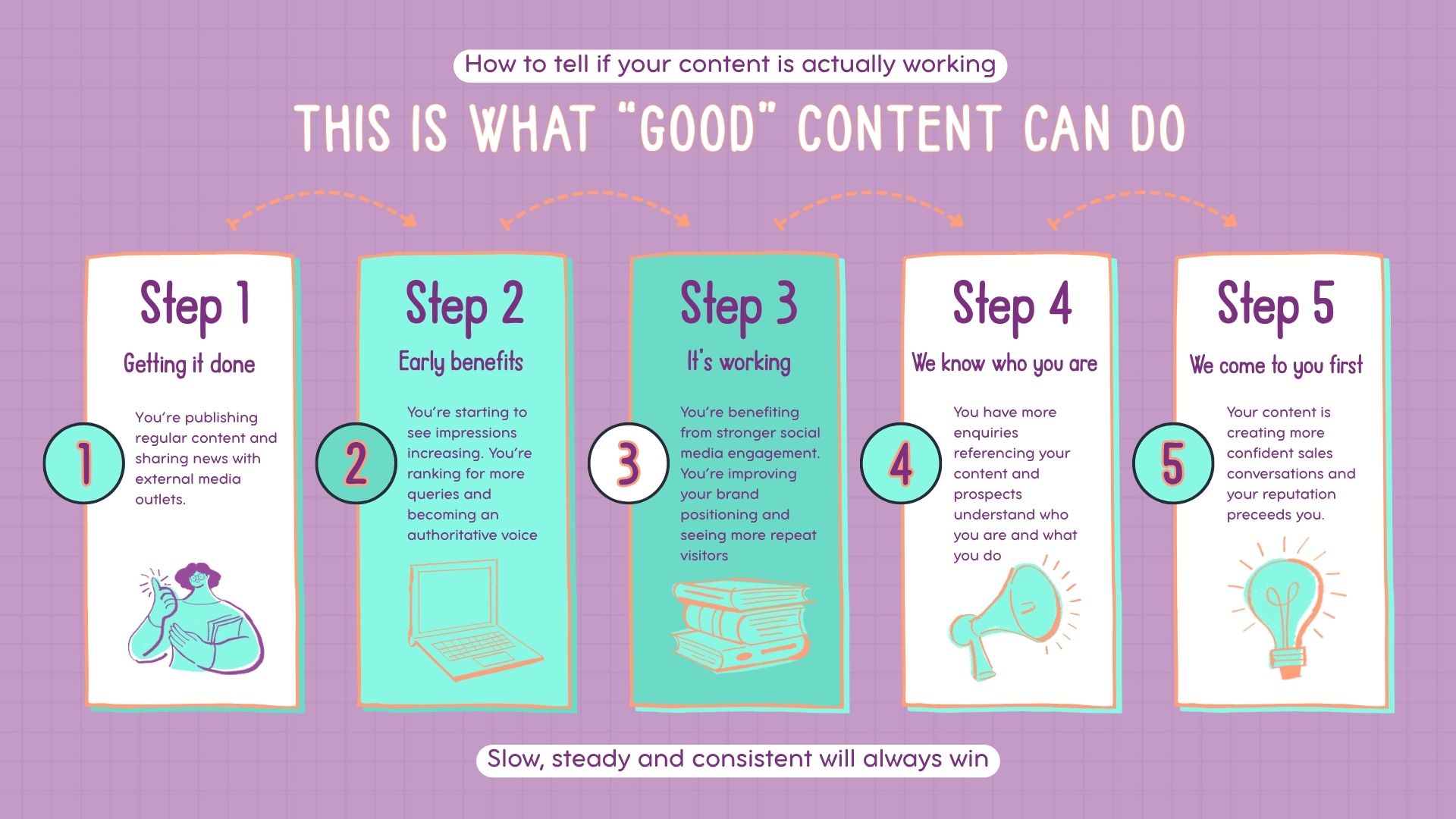
If you’re investing time in PR, reports or content, your goal isn’t just to stay visible.
It’s to build credibility, strengthen your position and give your customers a genuine reason to choose you.
Search engines, AI tools, and your customers are all looking for the same thing. They want to see clear, consistent signals that you know what you’re doing and that you can solve their problem or need. This is where having a simple way to track your visibility and progress over time becomes especially useful, especially when you’re trying to decide what to change or improve.
So, if you really want to know whether your PR or reports are working, you need to ask yourself one critical question.
Will this help build trust and move us closer to working together?
If you’re not sure whether your current PR, reports or content are doing that, I can help you step back and understand what’s working, what isn’t, and what to do next, whether that’s reviewing your existing content or helping you create something more structured from the start.